05 September 2017

Time flies!

Years go on and on... After close to 3000 amateur radio repairs (and some test equipment ones), I still find from time to time some real challenges. And my interest to learn more on the RF field are still here. So, I guess, that means all is going fine :-)

I have upgraded my lab quite a bit on last years. Here you have some pictures of the different parts of it. Please, don't be too hard telling me some areas are too crowded, I know and am working on that!

LAB1 is where I develop most of my dayly repair work. You never have too many displays on hand:


And it is also my main ham radio station (yes, hidden below some layers right now). This is half ot it. The other half is still more hidden:


LAB2 is where older (mostly tubed) ham gear is located, along an auxiliary workbench:


Then LAB3 is the R&D area:


This is it for the in-house area. There is more outside it, but it is now too crowded to be shown ;-)

Well, back to repair!!!

See you soon.

73 Jose EB5AGV

22 November 2013

Update

Judging by the low post activity on my blog, you could think I have no longer interest on radio repairs... No way!

What happens is exactly the opposite: since June 2012 I am working full time on radio repairs. You can check my professional WEB at: AGVradio

As you can imagine, the problem now is that I have little time to write on this blog. Well, it is true, but I also have lots of repair experience to share.

So, as time permits, I hope to start blogging again... let's see what happens!

Regards,

JOSE

03 May 2012

(Spanish) Bienvenida a los lectores de Radioaficionados (URE)

Quiero dar una bienvenida especial a todos los que han llegado por primera vez a estas páginas desde la revista de la URE. Es para mí un placer poder compartir con vosotros mis aventuras en esta interesante afición.
Espero que encontréis algo de interés, tanto en este BLOG como en mi WEB principal:

http://jvgavila.com/

o en alguno de mis otros BLOGS:

 http://sdr4everyone.blogspot.com.es/

 http://delcontenedor.blogspot.com.es/


73 JOSE EB5AGV

01 March 2012

A new repair project: Collins 30L-1 amplifier

Well, sometimes dreams come true... as it was the day when a ham friend offered a non working Collins 30L-1 amplifier. It was missing some parts (tubes included), but overall it was pretty fine and obviously repairable.

Here you have some pictures of it:


Since I got my S-line back in 1997 or so and then my KWM-2A in 1998, I was looking for a fixer-upper 30L-1... and now it has arrived. Great!!!


I have started a new page on my WEB to deal with its restoration:

EB5AGV's Workbench: Collins 30L-1 restoration

I am actively working to find missing parts and hope to complete the write up as repair progresses.

Yes, I am a happy camper :-)!

73 JOSE EB5AGV

03 January 2012

Happy New Year!

Hi all,

I am sorry for the lack of posts. As you could imagine, that means that I am still pretty busy with the radio repairs. I have been able, though, to regain some of the lost fun factor, by filtering better what I take to repair and also by scheduling some of my own equipment repairs mixed with the other ones. As a sample, I am now working on two large test equipment projects, which will be soon appear here as sepparate posts. So life goes on :-)!

I hope all of you have a nice 2012 which fullfills your best expectations.

Sincerely,

JOSE

15 September 2011

The Fun Factor

Sorry if this is not a technical post, but it is closely related with my amateur radio equipment repairs.
 
Back when I began to fix my own radios, at the end of the 1990s, it was a treat for me to get them working again. It was so nice that I began to buy nonworking radios just for the fun of fixing them. So the Fun Factor back then was high.

Then, some people around (other local hams) needed to fix their own rigs and I began to fix rigs for free for other people. Soon I found that there was too much work to do and, as a way to keep the flow controlled, I began to get some cash from the repairs. So far, so good: Fun Factor was again at a reasonable level, if not so high than before.

But now, some years later, I find myself overflown by rigs to fix and, luckily only sometimes, also by angry people who want the work done NOW. And CHEAP. So, steadily but irremissibly, the Fun Factor has gone down and down and down... and now is close to zero. I have almost completely stopped to use my own rigs and, seldomly, fix my own nonworking rigs (which I have in large quantity, waiting for care). So I am fixing other people rigs about 95% of my hobby time and just a 5% of the time is devoted to, for example, write on this BLOG (now you can understand why it has so few updates!)

But I have taken a decision: I want the Fun Factor back. So I plan to carefully filter what I am going to fix for other people. No more bulb changing, simple mods or even just admitting to fix abused rigs. I am sorry, this is not an NPO. I want to use my hobby time to learn about RF circuits, operate my radio station and fix my rigs. And, then, fix some other people rigs. But not the opposite!

Sorry for these ramblings but I needed to write this down so it will be an unbreakable decision. You will know if I succeed by the number of posts here!

Thanks for reading :-)

73 JOSE EB5AGV

28 February 2011

Back to SATs! (2)

Well, there were some problems with my antenna setup of last week... one of the problems is that I have replaced the sepparate rotor controls (Yaesu G-400RC and Kenpro KR-500) for a all-in-one Yaesu G-5600B (note that I have replaced only the control box, which I bought used some years ago). I have done this in order to control the rotors from the PC easily, as the G-5600B control includes internal relays and has buffered positioning signals.

But one problem is that it is a South referenced control... and my antennas were North referenced. This was not hard to fix :-)

Then a worse problem arised, as there was some miscalculation on the 2m elevation antenna and one director collided with the 6m boom from about 50º elevation... not a good thing!

In order to fix the bent element, I needed to access to the 2m Yagi. But it was too far to reach. So I modified the antenna position by displacing the elevation boom. Current positioning is shown on next picture, with the elevation antennas pointing to sky:


I have also reshuffled the rigs on my main radio station position, so now I have a rig devoted to SATs (Yaesu FT-847), another for Earth work :-) (Yaesu FT-736R) and another for local work (Kenwood TS-790E). Of course, all of them could be used in the others roles, but this is my first approach.


I have ordered an AMSAT-UK LVB Tracker Kit (I have ordered the cheapest one, as I plan to do a custom case and add my own display and buttons) and will work also on the FT-847 CAT control from a tracking program (I will look for a program which cares about Doppler)

So, all in all, things are progressing!

73 JOSE EB5AGV

20 February 2011

Back to SATs!

Well, not yet, but, after 10 years without elevation antennas, they are back in my tower !

Here you have a picture of the installation done during this weekend. Now is the turn for the tracking interface... more to come!!!


73 JOSE EB5AGV

25 October 2010

Yaesu FT-1000MP MkV repair

I have added a new page to my WEB about the repair of a seriously ill Yaesu FT-1000MP MKV


You can check it at:

http://jvgavila.com/ft1000mpv.htm

73 JOSE EB5AGV

24 May 2010

Worse than the H1N1... ceramic filter pandemic

Well, it could be a false alarm (pun intended) but lately I have been getting more and more rigs for repairs, and from diferent manufacturers, with bad Toko black ceramic filters (6 and 9 kHz by now)

I have fixed three rigs in the last few weeks with this problem, two Yaesu FT-897 and one Kenwood TS-2000. Symptoms could range from lower sensitivity, to cracking noises and, usually, you have both. There is also an interesting effect, at least on FT-897s, which is that they receive in DSB instead of SSB when filter fails.

I have opened one filter and it had some greenish looking residue on it, so I guess sealing had failed and moisture did the dirty job.

I would be interested in hearing other people experiences with those small "BLACK NOISIES" (*) (remember you saw it first here, (c) EB5AGV ;-) )

Best regards,

JOSE

(*) the equivalent to "BLACK BEAUTIES" caps in old boatanchors!

31 March 2010

R&S NV 1/156 VHF Multi-coupler

This is one project I had stored for a long time... I got the unit some time ago and worked on it to fix some transport damage and clean it:

EB5AGV's Workbench: Rohde & Schwarz NV 1/156 VHF MULTI-COUPLER repair

But, as I said in that page, it was deaf and, suspiciously, one of the tubes, an EC80 UHF triode, measured low in the unit's own multi-meter (a great idea, BTW)

Finally, I got some EC80 spares and was able to check it. Wow!!!. This unit was manufactured in 1966 so it is 44 years old (2 more than myself, hi!). But it still works fine and, even if its noise figure is for sure higher than the modern equivalent, as it is specified from 100 to 156MHz, it is perfectly usable for FM broadcasting, monitoring air band (around 120MHz) and, of course, 2 meters ham band.

Here you have one picture of the unit, still cover less, connected to two rigs:


The multi-coupler has 5 outputs so I will add more rigs to it and use as a monitoring system.

It is great to mix old technology with 21st century rigs :-)

73 JOSE EB5AGV

20 January 2010

Shack 2.0 up and running!

Well, I have finally my new shack setup!. It is an ongoing work but I have been able to work on half a dozen rigs so far on new workbench.

Here you have a picture of myself (courtesy of my friend Alf, EA5AMM) at the controls of the Enterprise... err, workbench :-D


More repair works to come soon!

73 JOSE EB5AGV

20 December 2009

Shack 2.0 Project: Second Part

Well, once workers were gone, I started working on the shack. I have put a new WEB page to document these works:

EB5AGV's Shack 2.0: Second Part

Here you have one picture of the current looks. Of course, still a work in progress:


73 JOSE EB5AGV

16 October 2009

Shack 2.0 Project

INITIAL CONDITION (1/OCT/2009)


UPDATED PICTURE (6/NOV/2009)


UPDATED PICTURE (13/NOV/2009)


Well, I am now in the middle of the shack rework!

I have put a new page in my WEB at:

EB5AGV's Shack 2.0 Project

I will update it frequently, so keep connected!

73 JOSE EB5AGV

12 August 2009

New addition to my RF lab: HP-8566A

Well, it has been (and continues to be) a big deal to have it working, but here you have my last addition to my RF lab: a 100Hz-22GHz HP-8566A Spectrum Analyzer


You can read about the repair and see plenty of pictures of the process at:

EB5AGV's Workbench: HP-8566A repair

Best regards,

JOSE

19 June 2009

Ten-Tec Paragon


I own a number of radio rigs from lots of different manufacturers (Yaesu, Kenwood, Icom, JRC, Drake, Collins, ...) but, until yesterday, I had no Ten-Tec in my collection. So my new Paragon is for me, besides a new toy, my very first Ten-Tec. I have fixed several Ten-Tecs over the years but I had none of my own.

This unit arrived in pretty good shape, with only some light dirt on it. I bought it as unworking in AM mode and generating extrange sounds at low frequencies. Obviously, I suspected of PLL problems as they are well documented all over the WEB... Well, I have not found yet any obvious problem with the rig in both aspects!. So I guess there could be an intermittent fault waiting to develop again.

Unit arrived with original User Manual (nice one, more like a Service Manual) and a non-original hand mike (which seems to be wired wrongly). It has an optional FM module, but no RS-232 module and no extra filters. Here you have some internal pics:


Only sign of previous repair I have located so far (I have not yet opened lower inner cover) is around the backup battery charging (I guess) circuit. BTW, battery holds a charge but memory and RTC are reset when power is out. So something is wrong here:


Despite the inclusion of the original Giehl EPROM manual in the back of the User Manual, this unit has an standard Ten-Tec EPROM on it, version 3.9:


I wonder if someone would sell me a Giehl EPROM...

I need to check the unit in detail but, so far, it seems to work pretty nicely.


UPDATE #1

I have just opened the inner bottom cover to check. There are good news!. Unit seems completely untouched. GREAT!!!

Here you have some pictures:


And now some more detailed pictures: this is from the PLL area. I have found that wiggling these connectors warbles the signal but this could be due to stray induced capacitances:

And this is the antenna discharge protection:


I will add more info as my work progresses.

73 JOSE EB5AGV

15 June 2009

What can we learn from AF-447 crash?

Well, I know this BLOG is not related to aviation but, taking into account that it seems most of the problems faced by the crew aboard the doomed AF-447 were electronic related, and this BLOG is about repairs, I am very interested in knowing what failed so badly to leave the tripulation completely in electronic darkness in that terrible night over the Atlantic.

It is clear for me that today commercial aviation needs electronics and that it would be impossible to fly without them. Fly By Wire is, IMHO, a big advantage over conventional controls, as it could be supervised by powerful computers aboard the plane. What we need is to know what failed in order to prevent it to fail again. And, at least, adding some extra info to the ACARS messages, as GPS location info, could help a lot finding the remains of the aircraft. Since I first read about the crash I wondered how, in this ultra-connected World, an airliner could be so, let's call it, off-line.

I am sure it will be possible to send real-time telemetry and audio data from the planes to a satellite based system, so the equivalent to the black boxes could be out of the plane and immediately available after a crash. And, even better, you could have an expert system analyzing all info so perhaps it could prevent, with some more anticipation, a large failure as the one which presumably generated the fatal end of Air France 447 flight.

Of course, this would cost money. Yes, I know. But how much would it cost to insurers, Airbus and Air France this accident?. How can you value a human life?. Not counting the huge effort to locate the remains and black boxes, which would be easier if there was more information available right now.

228 souls have died in an horrible accident, caused by technical failures (of course, triggered by powerful Nature forces). All what can be done to prevent other similar accidents should be done. We need to improve data communication with aircraft. It is a no brainer to have backup copies far from the computers which generate the data. So the same should be applied to aircraft data. We have the ways to do it and it is only a matter of work and money, both of them available to human beings.

Titanic was also unsinkable and now it rests in the deep sea. We know now that the Airbus 300 is not perfect and can be broken down. So we need to improve them (as all other airliners), as we did with big ships. And, for this, information is crucial.

RIP all 228 souls aboard AF-447. Your death will be sure a trigger for safer flights.

23 May 2009

Some news

Well, after long time without any update, I want to comment that I am very busy trying to get my shack upgraded, which will mean adding a new area, roughly similar to what I have now, so I can sepparate radio from lab. I will post pictures of the project as it evolves :-)

73 JOSE EB5AGV

17 January 2009

Yaesu FRG-8800 repair

Lately I spend most of my hobby time fixing rigs for other people. But this time I have fixed a rig for my collection. It is a Yaesu FRG-8800 receiver which suppossedly came with the VHF converter...

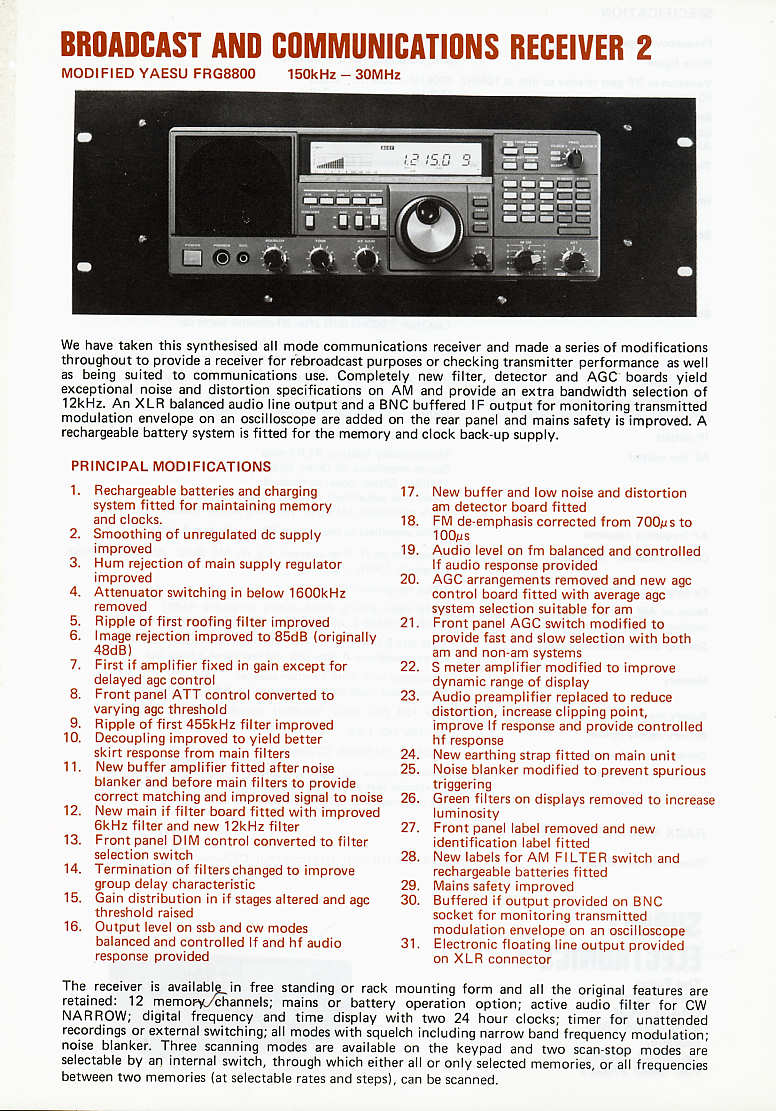
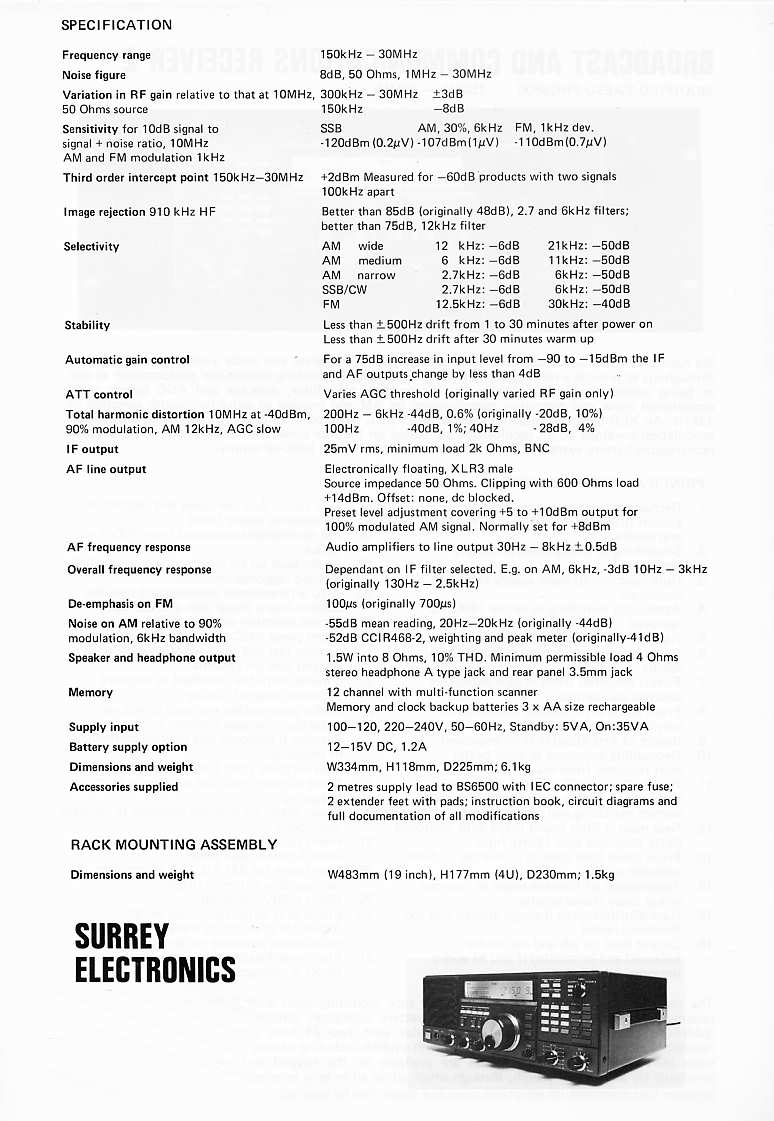
When I got it, I found a surprise. It is a heavily modified unit (called Broadcast Monitor Receiver 2) and there is NO VHF converter, but an extra module with balanced audio and IF output on its place, along some other PCBs and other internal mods. You can check what I am talking about here:

This is the company:

http://www.surreyelectronics.com/

This is the mod leaflet front page:

http://www.surreyelectronics.com/leaflets/Receiver2F.jpg

And this is the rear page:

http://www.surreyelectronics.com/leaflets/Receiver2R.jpg

Here you have some pictures:


Well, I knew it was in unworking condition and, really, it didn't work on arrival. No surprise here. I took the covers out to find some oxide in metal cans but mostly a clean receiver. This is the top side:


I polished the cans, dusted it out and started troubleshooting.

AM sort of worked but SSB was completely deaf. While turning the unit to check lower side, I heard some noise inside... and it was a lose piece of PCB!!!. I found it was a PCB corner and it had a trace on it... could this be the cause of the SSB deafness?. I fixed it by glueing and bridging it:


So I put back the PCB, hoping for the best... and no, it was WORSE!!!. Now AM was received faintly and SSB needed about 0.2V to be heard. So I went back to head scratching until I found that pulling the PCB a bit generated some better reception. So I decided to completely remove it:


I took some detailed pictures of the added PCBs:


As you can see, there are a couple IF filters in one PCB, a couple relays in another one and, I guess, a new detector on the third. The mods seem somewhat complex; I guess they are worth more than I have paid for the unit :-)

Looking closely I located the problem. There was another crack in a PCB corner.


I fixed it as follows, scrapping and adding some wire and solder on each crack:


Putting the PCB back got me a pretty hot working receiver :-)!!!. Here you have a very small video (sorry about the lousy quality):


So I decided it was time to clean the unit, removing knobs to clean them sepparately. I also replaced the four display light bulbs, as there was one bad, one dim and two with too much brightness. I put four new lamps.

Here you have some pictures of the cleaned unit, ready for alignment:


Alignment was mostly OK, just some Hertzs out in some oscillators. I used my GPS reference to be sure alignment was done OK.

And this is the result: a perfectly working receiver:


Success!!!